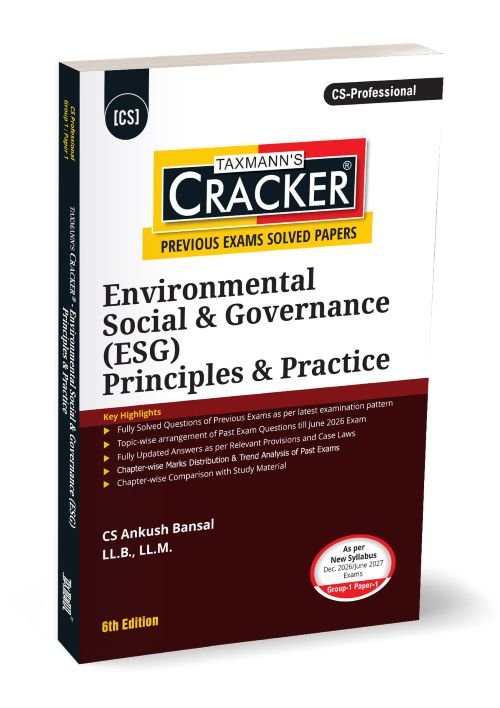
Taxmann CS Professional Principles & Practice of ESG Cracker By CS Ankush Bansal Dec 26 & June 27
$ 19.80
CS Professional ESG Cracker By CS Ankush Bansal Dec 26 & June 27 CS Professional ESG Cracker By CS Ankush Bansal Dec 26 & June 27 Descriptions Environmental, Social & Governance (ESG) Principles & Practice – CRACKER is a purpose-built, examination-oriented question bank—not a textbook. The entire body is a topic-wise compilation of past examination questions, reproduced as asked, answered in full, and refreshed to the current legal and regulatory position, so that a student who has finished reading the concepts can convert that reading into examination-ready answers. What distinguishes this paper—and what the book is engineered around—is that ESG is examined through descriptive, application-led questions rather than recall: detailed scenarios built on listed-company fact patterns (board composition under SEBI LODR, independent-director tenure and re-appointment, maximum directorships and penalties, secretarial-audit findings, risk registers) sit alongside concept questions, and each is answered in the point-wise, conclusion-led manner that earns marks. The answers carry their statutory anchors—Companies Act 2013, SEBI (LODR) Regulations 2015, Secretarial Standards, SEBI/MCA mandates and the relevant global frameworks—rather than generic prose. Beyond the dated past-exam questions, the author has added a large set of ‘Scoring Questions’: high-probability questions that have not yet appeared in a dated paper but follow directly from the syllabus and the Study Material. The Present Publication is the 6th Edition | June 2026, authored by CS Ankush Bansal, with the following noteworthy features: [Fully Solved Past-Exam Questions] Around 180 dated questions and sub-questions, each tagged with its session and marks, reproduced with complete, ready-to-write model answers that reflect the current descriptive, application-led format of the paper [Coverage Up to the June 2026 Exam] Every recent paper through June 2026 is captured and placed under the chapter to which it belongs [Answers Updated to Current Law & Case Laws] Model answers reflect the prevailing position under the Companies Act 2013, SEBI (LODR) Regulations 2015, applicable Secretarial Standards, and the latest SEBI/MCA and global ESG mandates. [Author-Curated ‘Scoring Questions’] About 159 high-probability, examinable questions beyond the dated papers, clearly flagged, to widen coverage of likely areas [Chapter-wise Marks Distribution Chart] A session-by-session marks table covering the last five sittings (June 2024 to June 2026), with a per-chapter average, so the student can see exactly where the marks concentrate [Previous Exams Trend Analysis] A question-number-level breakdown of those five papers (chapter, marks and category) for reading the examiner’s pattern. [Chapter-wise Comparison with the Study Material] A one-to-one mapping of each book chapter to its corresponding Study Material (ICSI module) chapter, so the book slots in beside the official material without gaps [Fully Solved June 2026 Question Paper] Included at the end, worked in the same applied style as the live paper, opening with a multi-part case study (Alchemy Pharmaceuticals Ltd.) and running through governance, risk and reporting answers The syllabus is delivered across three parts and 20 chapters, followed by the solved June 2026 paper. Indicative themes show the depth within each part: Part I — Governance and Sustainability (65 Marks) Conceptual Framework of Corporate Governance—definitions, theories (agency, stakeholder, stewardship), and governance in Indian scriptures (Vidur Niti, Shanti Parva) Legislative Framework of Corporate Governance in India Board Effectiveness/Building Better Boards—board composition under SEBI LODR Reg. 17, independent-director tenure and re-appointment, IiAS proxy-advisory norms, performance evaluation, directorship limits and penalties Board Processes through Secretarial Standards Board Committees—mandatory committees under the Companies Act 2013 vs SEBI LODR, and the role of the Audit, NRC, Stakeholders’ Relationship, CSR and Risk Management Committees Building Better Boards (merged with Chapter 3) Concept of Governance in Professional Managed Company & Promoters Driven Company Board Disclosures and Website Disclosures Data Governance—principles of integrity, transparency, accountability and ownership, audit, standardisation, change management and stewardship Stakeholders Rights Business Ethics, Code of Conduct and Anti-Bribery—Indian ethos (Sanathana Dharma), function-wise ethical issues, and the ICSI Anti-Bribery Code Board’s Accountability on ESG—Board vs Management roles, what constitutes ‘E’, ‘S’ and ‘G’, and the Environmental & Social Management System (ESMS) Environment Corporate Social Responsibility (CSR) Green Initiatives Governance Influencers—ICSI’s role, the CCGRT, secretarial/auditing standards, and ICSI governance awards Empowerment of the Company Secretary Profession Part II — Risk Management (20 Marks) Risk Management—definitions and the statutory mandate under Section 134(3), risk evaluation and quantification, risk-transfer mechanisms, types of risk, risk-identification tools, the Chief Risk Officer role, crisis management, business continuity planning, and internal controls Part III — Environment & Sustainability Reporting (15 Marks) Sustainability Audit; ESG Rating; Emerging Mandates from Government and Regulators—sustainability-audit evolution, ESG ratings, and a survey of Indian and global mandates (SEBI’s BRR→BRSR, EU SFDR and EU Taxonomy, the German Supply Chain Act, the Dutch Climate Agreement, Japan’s governance code, Canadian Securities Administration, ISO 26000, and the role of the Chief Sustainability Officer) Integrated Reporting Framework; GRI Framework; BRS Reporting—the IR framework’s seven guiding principles and value-creation model, the GRI framework, IFRS/IASB and ISSB context, and BRSR (including BRSR vs BRR) Solved Paper — June 2026 (Suggested Answers) The book is sequenced as an analytical layer, a solved-practice body, and a closing self-test: Planning Layer — The Chapter-wise Marks Distribution chart, the Previous Exams Trend Analysis and the Study-Material Comparison sit upfront, so revision can be planned before the chapters are opened Part → Chapter → Sub-Topic Flow — The three parts follow the syllabus architecture, and within each chapter the questions are clustered under named sub-headings (for example, Board Composition, Mandatory Committees, ESG – The Way Ahead) so related questions are practised together Consistent Question-and-Answer Unit — Each question shows its session and marks (or a Scoring Question tag); differently worded variants across sessions are joined by ‘OR’ so one answer prepares the student for every form; answers are point-wise, use tables where a comparison or list aids recall, and close with a conclusion Applied Questions — Multi-part case-study questions are reproduced with their full fact pattern, training the student in the scenario-reading the paper demands Solved Paper — The June 2026 paper appears in full as an end-to-end test against fresh questions. About The Author CS Ankush Bansal is a distinguished figure in the legal field, renowned for his extensive knowledge across Corporate, Civil, Criminal, General, and Personal laws. Ankush has made significant contributions to legal academia and practice, with a legal career spanning over eight years. Ankush holds impressive academic credentials, including a CS, B.Com., LL.B., and LL.M. from Delhi University. His scholarly works, widely recognised for their meticulous research and insightful analysis, have become essential readings for professional courses.