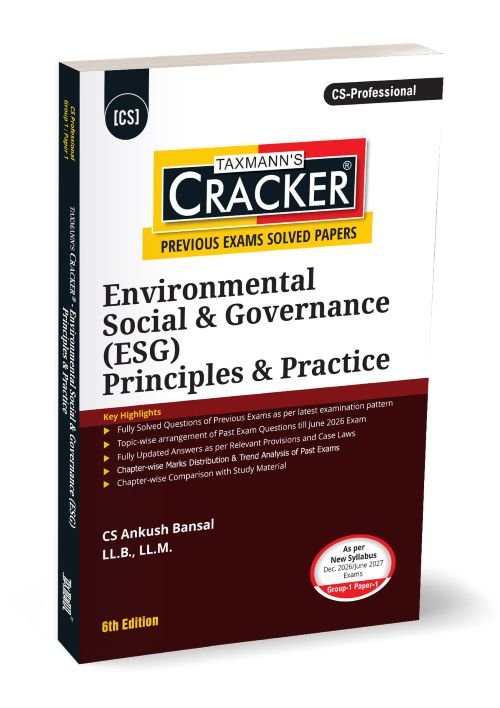
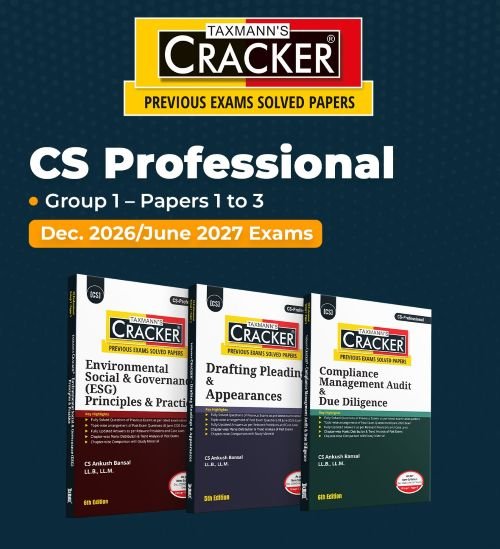
CS Professional Group 1 Cracker’s Ankush Bansal Dec 26 & June 27 CS Professional Group 1 Cracker’s Ankush Bansal Dec 26 & June 27 Description CRACKER COMBO for CS Professional – Group 1 (Papers 1 to 3) is a single COMBO that brings together the CRACKER editions of the three compulsory papers of CS-Professional Group 1—ESG: Principles & Practice (Paper 1), Drafting, Pleadings & Appearances (Paper 2) and Compliance Management, Audit & Due Diligence (Paper 3)—under one revision method. The defining idea is that none of these are textbooks—each is a purpose-built, examination-oriented question bank. Every title takes the questions ICSI has actually set, reproduces them as asked, sorts them topic-by-topic under named sub-headings inside each chapter, and answers each one in full—in the point-wise, statute-anchored, conclusion-led style that earns marks. What gives the COMBO its coherence is that all three papers are now examined in the same direction: away from recall and toward application. ESG is tested through descriptive, scenario-led questions built on listed-company fact patterns; Drafting rewards a reproduce-under-pressure specimen-drafting component; Compliance mixes descriptive theory with problem-based, threshold-driven practical questions. A solved question bank is the natural bridge for all three—it carries a student from ‘I have finished reading the concepts’ to ‘I can write the answer the examiner wants’ and doubles as the primary revision tool in the final weeks. Bought together, the three books form one continuous drill across the compulsory core of the group, closing each paper with the fully solved June 2026 paper. The Present Publication is the June 2026 Edition, authored by CS Ankush Bansal, with the following noteworthy features: [Fully Solved Past Papers, Reproduced as Asked] Questions appear in their original form and are answered with complete, ready-to-write model answers reflecting the latest examination pattern—not paraphrased theory [A Four-Way Tagging System That Directs Revision Time] Every question is either stamped with its sitting and exact marks (e.g., Dec. 2025 (5 Marks), including sub-part splits such as (2 3=5) and (1×5=5)), or flagged by the author as a Scoring Question (high-recurrence), an Expected Question (anticipated topic) or an ICSI Study-Material Question (sourced from the official module). The student sees at a glance both the weight of a question and its source [Author-Curated Questions Beyond the Dated Papers] High-probability questions that have not yet appeared in a dated paper but follow directly from the syllabus and Study Material (around 159 such ‘Scoring Questions‘ in ESG alone), widening coverage of likely areas [‘OR’ Consolidation of Variants] Differently worded versions of the same question across sittings are joined by ‘OR’, so one answer prepares the student for every form the examiner might use [Answers Updated to Current Law & Case Law] Model answers carry their statutory anchors rather than generic prose: the Companies Act 2013, SEBI (LODR) Regulations 2015, Secretarial Standards, ICSI standards, the latest SEBI/MCA mandates and the relevant global frameworks [A Planning Layer at the Front of Every Book] Three reference tables sit upfront so revision can be planned before the chapters are opened: Chapter-wise Marks Distribution Chart — Session-by-session across the five recent sittings (June 2024 → June 2026) with per-chapter averages Previous Exams Trend Analysis — A question-number-level breakdown (chapter, marks, category) for reading the examiner’s pattern Chapter-wise Comparison with the ICSI Study Material — A one-to-one map of each book chapter to its official module chapter, so the book slots in beside the official material without gaps [Disciplined, Mark-Friendly Answer Architecture] Answers are point-wise, use tables wherever a comparison or list aids recall, and close with a conclusion; case and practical questions are worked through an explicit issue → legal provision → analysis → conclusion/advice chain [A Full Solved June 2026 Paper to Close Each Title] Worked in the same applied style as the live paper, for an end-to-end, timed rehearsal against the very latest examination Each volume in the CRACKER COMBO follows a systematic and student-friendly design: Paper 1 — ESG: Principles & Practice | 100 Marks Across 3 Parts, 20 Chapters Engineered for a paper examined through application: detailed listed-company scenarios (board composition under SEBI LODR, independent-director tenure and re-appointment, maximum directorships and penalties, secretarial-audit findings, risk registers) sit alongside concept questions, all answered with their statutory anchors ~180 fully solved dated past-exam questions and sub-questions (each tagged with session and marks) plus ~159 author-curated Scoring Questions Part I — Governance & Sustainability (65 Marks): Conceptual framework of corporate governance (agency, stakeholder and stewardship theories, and governance in Indian scriptures — Vidur Niti, Shanti Parva); legislative framework; board effectiveness (SEBI LODR Reg. 17, ID tenure/re-appointment, IiAS proxy-advisory norms, performance evaluation, directorship limits and penalties); board processes through Secretarial Standards; board committees (Companies Act 2013 vs SEBI LODR — Audit, NRC, Stakeholders’ Relationship, CSR, Risk Management); governance in professionally managed vs promoter-driven companies; board and website disclosures; data governance (integrity, transparency, accountability, ownership, stewardship); stakeholders’ rights; business ethics, code of conduct and anti-bribery (Sanathana Dharma ethos, the ICSI Anti-Bribery Code); the Board’s accountability on ESG (Board vs Management, what constitutes ‘E’, ‘S’ and ‘G’, the ESMS); environment; CSR; green initiatives; governance influencers (ICSI, the CCGRT, governance awards); and empowerment of the CS profession Part II — Risk Management (20 Marks): The statutory mandate under Section 134(3), risk evaluation and quantification, risk-transfer mechanisms, types of risk, risk-identification tools, the Chief Risk Officer role, crisis management, business continuity planning and internal controls Part III — Environment & Sustainability Reporting (15 Marks): Sustainability audit and ESG rating; emerging Indian and global mandates (SEBI’s BRR→BRSR, EU SFDR and EU Taxonomy, the German Supply Chain Act, the Dutch Climate Agreement, Japan’s governance code, the Canadian Securities Administration, ISO 26000, and the Chief Sustainability Officer role); the Integrated Reporting framework (seven guiding principles and the value-creation model); the GRI framework; IFRS/IASB and ISSB context; and BRSR (including BRSR vs BRR) Closing Self-test: the June 2026 paper, opening with a multi-part case study on Alchemy Pharmaceuticals Ltd. and running through governance, risk and reporting answers Paper 2 — Drafting, Pleadings & Appearances | 14 Chapters, 2 Parts A self-contained companion for the one Group-1 paper that demands ready, reproducible drafts under exam conditions. 470 questions, the great majority being past-exam questions tagged by sitting and marks, spanning the mid-2000s through June 2026; 25 specimen drafts embedded directly in the answers Anchored in leading precedents—Mohiri Bibi v. Dharmodas Ghose, Suraj Lamp & Industries v. State of Haryana, Prakash Gupta v. SEBI, SEBI v. Bhavesh Pabari—alongside the governing provisions Part I — Drafting & Conveyancing: Types of documents; general principles of drafting; laws relating to drafting and conveyancing; drafting of agreements, deeds and documents; commercial contracts; documents under the Companies Act 2013; the art of opinion writing; and commercial contract management Part II — Pleadings & Appearance: Judicial and administrative framework; pleadings; the art of advocacy and appearances; applications, petitions and appeals under the Companies Act 2013; adjudications and appeals under SEBI laws; and appearance before other regulatory and quasi-judicial authorities Instruments and proceedings tested: Business communications (circulars, public notices, letters of credit, bank guarantees, show-cause notices); deeds (gift, and mortgage variants—deposit of title deeds, usufructuary, redemption); commercial agreements (joint venture, foreign collaboration, employment, family settlement, amalgamation, debenture trust deeds, underwriting); corporate documents (CSR resolutions, powers of attorney); reasoned legal opinions; and pleadings and appearances (plaints, written statements, special leave petitions, affidavits, memoranda of appeal) before the NCLT, NCLAT, SEBI and SAT Weighting at a glance: Laws relating to Drafting and Conveyancing is the heaviest chapter by a wide margin (≈32 marks average across the five recent sittings), followed by Adjudications and Appeals under SEBI Laws (16), Drafting of Agreements, Deeds and Documents (12) and Types of Documents (11) Closing self-test: The complete June 2026 paper with suggested answers Paper 3 — Compliance Management, Audit & Due Diligence | 100 Marks, 2 Parts (40:60) A wide, statute-heavy syllabus distilled into a focused, repeatable drill, with answers folding in the most recent regulatory change Every previous-exam question solved in full; the question pool reaches back to 2012 and is integrated topically through the December 2025 sitting (the period the current examiner draws from most), with the separately set June 2026 paper closing the book. Part I — Compliance Management (40 Marks): Compliance framework; documentation and maintenance of records; signing and certification; legal framework governing Company Secretaries; values, ethics and professional conduct; non-compliances, penalties and adjudications; and reliefs and remedies. Part II — Audit & Due Diligence (60 Marks): Concepts of various audits; audit engagement; audit principles and techniques; audit process and documentation; forming an opinion and reporting; secretarial audit; internal and performance audit; peer review and quality review; and due diligence. Laws, standards and forms tested: The Companies Act 2013 (offence, adjudication and audit provisions); the Company Secretaries Act 1980 and its professional-misconduct schedules (Second Schedule, Part I, Clause 7); the SEBI (LODR) Regulations; the ICSI Auditing Standards CSAS-1 to CSAS-4; Secretarial Standard SS-1; and statutory forms MR-3, MGT-7, MGT-8 and AOC-4—both descriptive and practical (problem-based) questions are covered Current to the latest law: Answers absorb the SEBI (LODR) Third Amendment 2024 (Regulation 24A on secretarial-auditor tenure and material subsidiaries) and the MCA’s decriminalization/e-adjudication framework. Closing self-test: The complete June 2026 solved paper, with answers carrying explicit Analysis, Conclusion and Advice sub-headings Each CRACKER—and the combo as a whole—runs as three layers: An Analytical Planning Layer — The Marks Distribution chart, Previous Exams Trend Analysis and Study-Material Comparison sit at the front of every book, so a student plans where to spend time before opening a single chapter. A Solved-practice Body, Built on a Consistent Question→Answer Unit — The parts follow the syllabus architecture: Within each chapter, questions are clustered under named sub-headings (for example, Board Composition, Mandatory Committees, ESG – The Way Ahead in ESG; Types of Due Diligence, Process and Stages of Due Diligence, Factors to be Kept in Mind in Compliance), so related problems are practised together Every question is stated, tagged with its source/marks (or author flag), and immediately followed by a worked answer; variants are joined by ‘OR’; comparisons are set out in tables (e.g., the deal-breaker/diluter/cautioner/maker classification in Due Diligence) Applicability and numerical problems are solved step-by-step against the relevant thresholds, and multi-part case studies are reproduced with their full fact pattern to train the scenario reading that each paper now demands A Closing Full-length Rehearsal — The June 2026 paper appears in full, worked end-to-end, as a timed self-test against fresh questions. About the Author – CS Ankush Bansal is a distinguished figure in the legal field, renowned for his extensive knowledge across Corporate, Civil, Criminal, General, and Personal laws. Ankush has made significant contributions to legal academia and practice, with a legal career spanning over eight years. Ankush holds impressive academic credentials, including a CS, B.Com., LL.B., and LL.M. from Delhi University. His scholarly works, widely recognised for their meticulous research and insightful analysis, have become essential readings for professional courses.