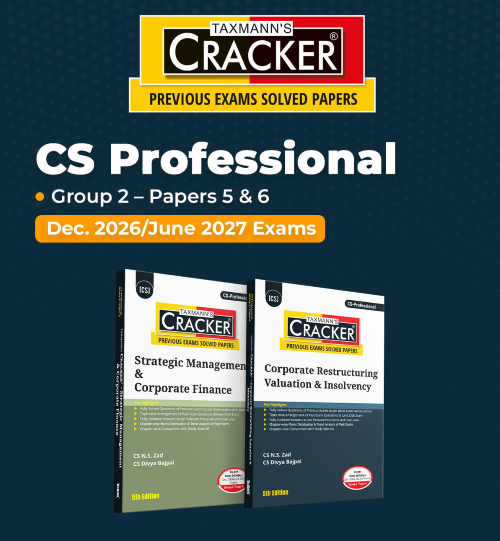
CS Professional Group 2 Combo Cracker Papers 5 to 6 By N.S. Zad & Divya Bajpai Dec 26 & June 27
$ 8.63
CS Professional Cracker Papers 5 to 6 By Ankush Bansal Dec 26 & June 27 CS Professional Cracker Papers 5 to 6 By Ankush Bansal Dec 26 & June 27 Description CRACKER COMBO for CS Professional – Group 2 (Papers 5 & 6) pairs the two CRACKERs that decide a candidate’s result in Group 2 of the CS-Professional programme (ICSI New Syllabus 2022) — the module that pairs heavy computation with heavy statute: Strategic Management & Corporate Finance – CRACKER (Paper 5 | SMCF) Corporate Restructuring, Valuation & Insolvency – CRACKER (Paper 6 | CRVI) Neither book re-teaches the syllabus. Each one reconstructs the paper exactly as the ICSI sets it—assembling the questions that have genuinely appeared in past examinations, sequencing them topic-wise within each chapter, and pairing every question with a fully developed model answer written in the form the examiner rewards. The pairing is logical because both papers test the same dual ability: discursive, application-led reasoning (strategy formulation, restructuring rationale, scenario judgement) and provision-heavy, computation-led discipline (fund-raising mechanics, DCF/NAV valuation maths, IBC procedure). Each paper is out of 100, and the official ICSI part-weightings explain how each book is built: Paper 5 — Strategic Management (40 marks) & Corporate Finance (60 marks); the heavier finance weighting mirrors the book’s 12 finance chapters against 6 strategy chapters Paper 6 — Corporate Restructuring (40), Valuation (20) & Insolvency, Liquidation & Winding-up (40); exactly the three-domain spine of the book, plus an integrated case-study layer Together they form a single revision, self-testing and answer-writing toolkit for the final, decisive stretch—converting conceptual reading into structured, time-bound, mark-earning answers across all of Group 2’s quantitative and statutory demands. The Present Publication is the June 2026 Edition, authored by CS N.S. Zad & CS Divya Bajpai, with the following noteworthy features: [Common to both CRACKERs] Topic-wise Solved Past Papers — Fully solved previous-exam questions, arranged topic-wise under subject sub-headings and folded into the relevant chapter bodies, so a single concept can be drilled across multiple years in one place Examiner-style Model Answers — Written to the depth and form the examiner expects, organised under clear headings and sub-points so they can be reproduced under time pressure Anchored to the Governing Law — Answers tied to the law in force and fully updated to current provisions, amendments and judicial precedents, with precise section references throughout Step-by-step Worked Solutions — Complete solutions for numerical, valuation and computation questions, with working notes and reasoned concluding decisions Marks Distribution & Trend Analysis — Chapter-wise, with every past question classified as descriptive or practical (application/problem-based) for high-yield, targeted revision Mapping with the ICSI Study Material — Chapter-wise comparison for friction-free use alongside the official module Visual Learning Aids — Diagrams, flowcharts, comparative tables and stage/process maps throughout to aid understanding and recall [Specific to Paper 5 — Strategic Management & Corporate Finance] Coverage up to June 2026 — Past questions covered up to and including the June 2026 examination Provision-precise Answers — Tied to the exact provision in force—e.g., the Companies Act 2013, the Companies (Share Capital & Debentures) Rules 2014, and the SEBI ICDR and LODR Regulations Fully Worked Numericals — Problem-based questions (project appraisal, capital budgeting) solved with working notes, present-value tables and a reasoned concluding decision Scenario Questions in Tabular Form — Application/scenario questions resolved through tabular analysis, so eligibility tests and comparative assessments reproduce cleanly in the answer book Labelled ‘Problems’ for Drilling — Recurring numericals set out as separately labelled ‘Problems’ for focused practice [Specific to Paper 6 — Corporate Restructuring, Valuation & Insolvency] Standalone Solved June 2026 Paper — The June 2026 paper reproduced in full as a separate, fully solved paper with suggested answers, and additionally mapped chapter-wise in the trend analysis Current Case Law & Regulator Circulars — Leading case law (e.g., S.K. Gupta v. K.P. Jain) and the latest regulator circulars (e.g., the IBBI’s VRIN circular) embedded directly in the text Worked Solutions & Process Maps — Step-by-step solutions plus document checklists and stage-wise process maps for procedural chapters—e.g., the document set and the Stage 1–8 NCLT route for a scheme of amalgamation. Dedicated Case-Study Chapter — Built specifically for the 20-mark integrated application component of the current paper Trend Analysis (June 2022 – June 2026) — Covering past exams across this window, with each question classified practical or descriptive Each volume in the CRACKER COMBO follows a systematic and student-friendly design: Paper 5 — Strategic Management & Corporate Finance (2 Parts | 18 Chapters) Part I – Strategic Management (40 marks): Introduction to Strategic Management; Analysing External & Internal Environment; Business Policy & Formulation of Functional Strategy; Strategic Analysis & Planning; Competitive Positioning; Managing a Multi-Business Firm & Analysing Strategic Edge Part II – Corporate Finance (60 marks): Sources of Corporate Funding; Raising of Funds from Equity & Procedural Aspects – Public Funding; Real Estate Investment Trusts (REITs); Infrastructure Investment Trusts (InvITs); Raising of Funds – Private Funding; Raising of Funds – Non-Fund Based; An Overview on Listing & Issuance of Securities in International Financial Services Centre (IFSC); Raising of Funds from Debt & Procedural Aspects; Foreign Funding – Institutions; Foreign Funding – Instruments, Laws & Procedures; Role of Intermediaries in Fund Raising; Project Evaluation Paper 6 — Corporate Restructuring, Valuation & Insolvency (3 Domains | 27 Chapters) Corporate Restructuring (40 marks) — Types of restructuring (mergers, demergers, reverse mergers, takeovers, slump sale, joint ventures); acquisition of company/business; planning and strategy; the merger and amalgamation process; documentation, accounting, taxation and stamp-duty aspects (including set-off and carry-forward of accumulated losses and unabsorbed depreciation under section 72A and amortisation under section 35D of the Income-tax Act 1961); regulation of combinations under competition law; regulatory approvals of schemes; fast-track mergers; and cross-border mergers Valuation (20 marks) — Valuation of business and assets across two dedicated chapters, covering the principal methodologies (Discounted Cash Flow, Net Asset Value, comparable-company multiples, premium-price brand valuation), equity-share valuation considerations (size of block, liquidity, dividend record), valuation documentation, and the regulatory framework for valuers—the Companies (Registered Valuers and Valuation) Rules 2017, SEBI valuation requirements, and recent IBBI measures such as the Valuation Report Identification Number (VRIN) Insolvency, Liquidation & Winding-up (40 marks) — The IBC framework and the evolution of insolvency law in India, the UK and the USA; the role and constitution of the IBBI and the IPA/IP/IU intermediaries; application for the CIRP; the role, functions and duties of the IP/IRP/RP; resolution strategies; conduct of Committee of Creditors meetings; preparation and approval of the resolution plan; the pre-packaged insolvency resolution process; cross-border insolvency; liquidation on/after failure of the resolution plan; voluntary liquidation; debt recovery and SARFAESI; winding-up by the Tribunal under the Companies Act 2013; and strike-off and restoration of the name of a company and LLP Integrated Case Studies — A separate chapter of long-form, multi-part business scenarios requiring candidates to apply restructuring, valuation and insolvency law together within a single fact pattern (built for the paper’s 20-mark application component) Across both books, the structure follows a uniform, exam-centric architecture: Paper 5 — Strategic Management & Corporate Finance Two-part Organisation — Mirrors the paper’s architecture (Strategic Management = Part I; Corporate Finance = Part II) Analytical Front Section — Precedes the chapters, so revision can be planned before turning to the questions Session & Marks Tagging — On every past-exam question, with recurring numericals set out as separately labelled ‘Problems’ Descriptive vs Practical Classification — Of past questions, making weightage and question style clear at a glance Paper 6 — Corporate Restructuring, Valuation & Insolvency Three-Part Architecture (27 Chapters) — Part I – Corporate Restructuring (Ch 1–11); Part II – Valuation (Ch 12–13); Part III – Insolvency, Liquidation & Winding-up (Ch 14–26); followed by a standalone Case Study Based Questions chapter (Ch 27) and the Solved June 2026 paper Topic-wise Sequencing — Within every chapter, each question tagged by exam session and marks Examiner-style Answers — Narrative answers in prose, computation answers worked stepwise, procedural answers laid out as checklists and stage tables Coverage Through December 2025 & Standalone June 2026 Paper — Chapter bodies run through December 2025, plus a fully solved June 2026 paper mapped question-by-question against the chapters in the Trend Analysis One-to-One ICSI Mapping — The 26-chapter spine maps directly to the ICSI Study Material’s 26 study lessons, while Chapter 27 supplies the integrated-question format the official material does not isolate. About the Author – N.S. Zad obtained his Commerce degree from Shivaji University, Kolhapur, and cleared the CS Final Exam in June 2005, conducted by the Institute of Company Secretaries of India. He has been teaching for the last ten years and has extensive teaching experience in various professional courses, including CA, CS, and CWA, at the IPCC/Executive and Final Levels. He has practical experience working with medium and large-sized organisations and firms of practising company secretaries. CS Divya Bajpai is a distinguished Practising Company Secretary with a Commerce degree from Banaras Hindu University (BHU), Varanasi. She successfully cleared the CS Final Exam in June 2016, administered by the Institute of Company Secretaries of India (ICSI). In 2019, she was an active member of the Women Empowerment Committee of the Northern India Regional Council of ICSI.